Monthly Corner
Laura Hughston - Blog
Arnoux Mouafo Nopi & Dimitri Tsona Zapzi - Article
Prof. Wangari Mwai and Prof. Catherine Ndungo - BOOK
- Understanding Gender and Identity Through The Gender Dictionary
Publisher: Bleeding Ink Scribes
RAI SENGUPTA - gender-transformative evaluation tools
This synthesis draws on evidence from 17 humanitarian evaluations across diverse crisis settings. It identifies key feminist evaluation innovations across four domains - design, methods, analysis, and ethics - illustrating how feminist principles can be embedded throughout the evaluation process. It also surfaces broader shifts required at policy, institutional, and practice levels to realise the transformative potential of feminist approaches in humanitarian contexts.
The toolkit translates these insights into applied guidance for evaluators and organisations. It provides step-by-step support across the full evaluation cycle, including planning, design, methods, analysis, ethics, and dissemination. Drawing on global feminist evaluation practice, humanitarian guidance, and gender evaluation standards, it includes adaptable tools, participatory and arts-based methods, guiding questions, and templates for field application.
Ritu Dewan & Swat Raju - Article
-
In Promises & Reality 2026 Citizen’s Review of Year 2 of the NDA-III Government. Coordinated by Wada Na Todo Abhiyan, June 20, 2026. pp 94-100.
UTTHAN - Research Report
Traversing the path with women farmers in their fields and in our reflections/writings, a stark observation was the sheer lack of localized and regional vocabulary and terminology to adequately capture and communicate the understanding of climate change and mitigation strategies, informed by the unique experiences and needs of small and marginal women farmers. This is what propelled our research - to examine how women farmers perceive, express, experience, and respond to climate variability across
Our Research Report centres the lived experiences, generational knowledge, and resilience strategies of small and marginal women farmers from the coastal (Bhavnagar) and hilly (Dahod & Panchmahal) regions i.e two contrasting agro-climatic zones of Gujarat. Through their voices, the study reveals exactly how climate change intersects with gender, land rights, labour burdens, and food security.
Events
Vacancies
About the job
At Includovate, we are expanding our Pacific Research & Evaluation Talent Pool and inviting researchers, evaluators, consultants, and development practitioners to join a growing network of professionals committed to creating meaningful social impact.
As a feminist research incubator and certified social enterprise, Includovate works with partners including UNICEF, UNFPA, the ILO, governments, and development organisations across 23+ countries. Our work spans gender equality, social inclusion, health, disability, youth, climate, WASH, market systems, and other development priorities.
We are particularly keen to connect with experts from:
📍 Papua New Guinea
📍 Solomon Islands
📍 Vanuatu
📍 Timor-Leste
📍 Fiji
📍 Samoa
📍 Tonga
📍 Indonesia
📍 Australia
and across the wider Pacific region.
We welcome expertise in:
✓ Research, Monitoring, Evaluation & Learning
✓ Gender Equality & Social Inclusion
✓ Health & SRHR
✓ Disability Inclusion
✓ Youth Development
✓ Climate & Environment
✓ WASH
✓ Market Systems Development
✓ Governance & Community Development
Whether your expertise lies in data collection, research, evaluation, technical advisory, facilitation, or team leadership, we would love to hear from you.
By joining our Talent Pool, you become part of a trusted network of professionals who may be considered for future research, evaluation, advisory, and consulting opportunities across the Pacific region and beyond.
🔗 Register here: https://lnkd.in/eyF66S7H

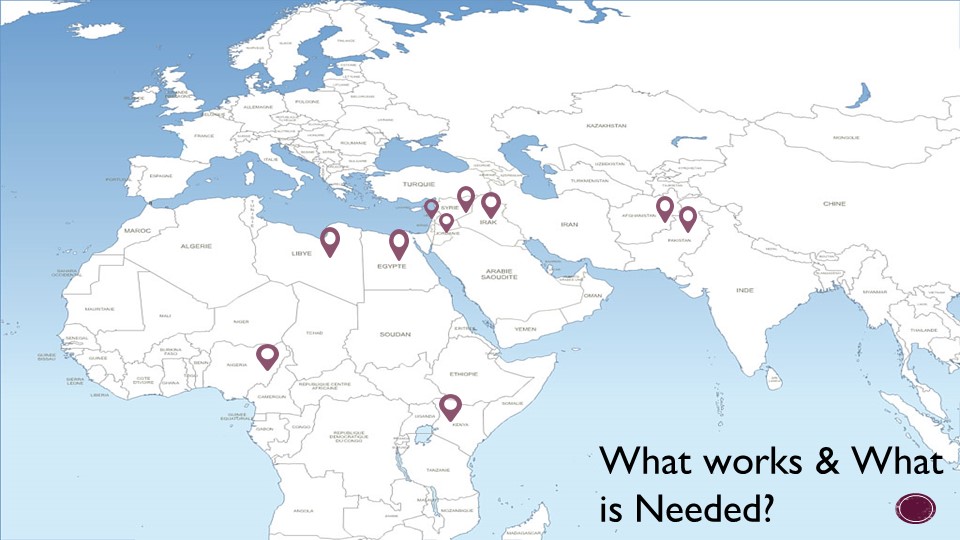
Evaluation in Conflict & Fragility - What works, what doesn’t & what do we need more of?
By Rania Fazah
During one of my interviews (meetings) with a woman volunteer in Nigeria active in deradicalization programs, a woman mid-40s wearing the traditional outfit, covering herself from head to toe with a colorful pattern! My assumption when I met her, this is a happy woman! (in conflict contexts don’t assume peace fighters are happy). I asked her what was her motivation to join the program to deradicalize youth? Why she chose to get involved with the “BOKO Haram” men. She looked me in the eye and said: “I did not choose them, they chose me! They took my baby and my man! They won the minds and hearts of both my kid and husband and recruited them… I lost 2 men to them, and I want them back. I am bedfellows with Boko Haram!” She continued to say “I was nobody, I suffered stigma and exclusion for being a mom of a dead Boko Haram fighter, a widow of a Book Haram fighter no one would talk to me, no one would even sell me rice! But I know why my son went, and why my man went? They wanted to be seen! I want to be seen also… I want to be heard! This program did not only deradicalized 23 young men; it revived my soul and made me visible!”
continue reading: http://www.elephas-consultants.com/2020/06/11/evaluation-in-conflic...
Add a Comment
© 2026 Created by Rituu B Nanda.
Powered by


You need to be a member of Gender and Evaluation to add comments!
Join Gender and Evaluation